
Why Vetting Matters More Than Price
The cheapest quote from China is rarely the cheapest part. Buyers who have been burned usually tell the same story: the quote was excellent, the samples were fine, and then the production batch arrived with the wrong material, out-of-tolerance bores, or cosmetic defects the supplier never mentioned. Almost every one of those stories could have been avoided with a structured vetting process before the first PO.
This checklist is written from the supplier side. We know what a serious buyer asks for, what a serious shop can answer immediately, and which questions tend to make a weak supplier go quiet. Use it as a scorecard. You do not need a perfect score on every point, but a supplier who fails several of these is telling you something.
The 15-Point Checklist
1. Verify the business license
Every legitimate Chinese manufacturer has a business license issued by the State Administration for Market Regulation, with a unified social credit code (an 18-character alphanumeric string). Ask for a copy. Then check the company name on the license matches the name on the quote, the invoice, and the bank account you will be paying. A mismatch between the trading name and the legal entity is not automatically a problem (many factories use an English trading name), but it should be explained clearly. Also check the registered business scope includes manufacturing or machining, not just trading. A trading company is not necessarily bad, but you should know whether you are talking to the people who own the machines.
2. Check ISO 9001 certification properly
Ask for the ISO 9001:2015 certificate, and do not stop at the PDF. Check the certificate number against the issuing certification body's online register, confirm the expiry date, and confirm that the certified scope covers CNC machining of the kind you need. A certificate that is expired, issued by a body you cannot find, or scoped to "trading of hardware" is a yellow flag. ISO 9001 does not guarantee good parts, but a current certificate from a recognized body means the shop has a documented quality system and has been audited against it.
3. Ask for sample FAI and CMM reports
This is one of the most revealing requests on the list. Ask the supplier to send a redacted First Article Inspection report and a CMM report from a recent job. A capable shop will have these on file and will send them within hours. Look at the format: does the FAI list every dimension from the drawing with nominal, tolerance, measured value, and pass/fail? Does the CMM report come from actual CMM software with probe data, or is it a typed spreadsheet? A shop that cannot produce a sample report, or sends one that is obviously hand-filled, probably does not inspect the way you need them to. We describe our inspection workflow on the quality page.
4. Request a live factory video call
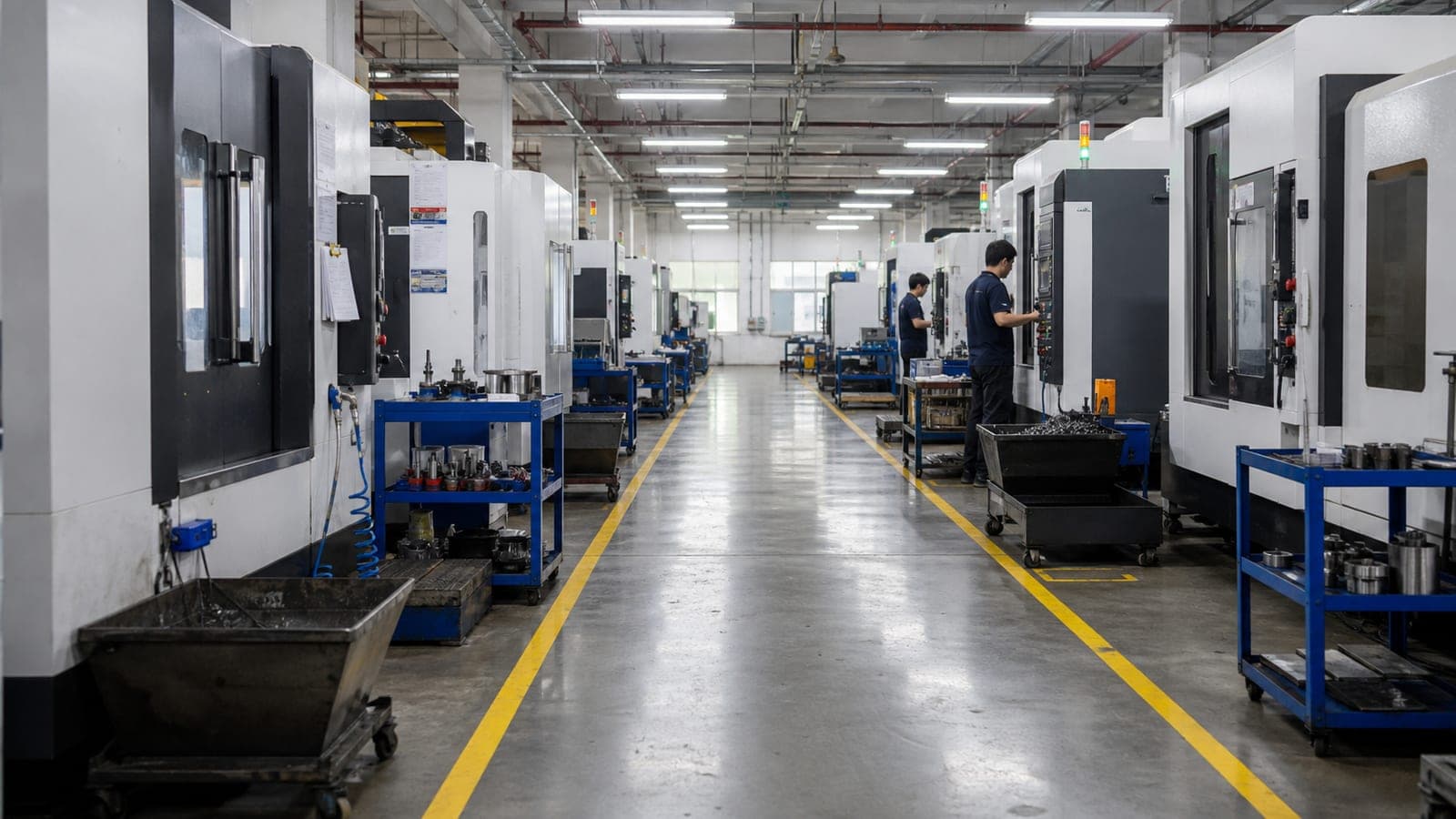
Photos can be borrowed. A live video walk-through cannot. Ask for a 15 to 20 minute call where someone walks through the shop floor with a phone. Count the machines. Look at whether they are running. Look at the inspection area: is there a CMM, are there surface plates, height gauges, and calibrated instruments with calibration stickers? Look at the material rack and whether stock is labeled. Look at the general housekeeping. You will learn more in 15 minutes of live video than from any brochure.
5. Confirm in-house capacity and what is subcontracted
Ask directly: how many CNC machining centers and how many lathes do you operate in-house, and which processes do you send out? Every shop subcontracts something (anodizing and plating are almost always external). What you want to avoid is discovering that the "factory" you are dealing with subcontracts the machining itself, which means you have no visibility into who actually makes your parts. A straightforward answer like "18 machining centers and 20 lathes in-house, finishing by approved subcontractors" is what you are looking for.
6. Judge the quality of DFM feedback
Send a real drawing, ideally one with a deliberate minor issue (an unnecessarily tight tolerance, a sharp internal corner, a thin wall). A good supplier will come back with specific, engineering-literate comments: "the 0.5 mm internal radius in pocket B requires a 1 mm end mill and will triple cycle time, can we use R1.5?" or "the ±0.005 mm on the outer flange is achievable but adds cost, is it functional?" A weak supplier will simply quote the drawing as-is, or reply "no problem" to everything. DFM feedback quality is the single best predictor of how the supplier will behave when something goes wrong in production.
7. Measure communication response time and clarity
During the quoting phase, track how long replies take and how clearly they answer your questions. Within 24 hours for a quote is a reasonable standard. Same-day for simple questions during the working week is what good suppliers achieve. Pay attention to whether your contact answers the question you asked, or a different question. Also note the time zone overlap: a Shenzhen supplier is 12 to 15 hours ahead of the US and 6 to 8 hours ahead of Europe. Good suppliers work around this with early or late shifts for sales staff; ask how they handle urgent issues outside Chinese working hours.
8. Get the NDA signed before sharing anything sensitive
A professional supplier will sign a mutual NDA without fuss, and the better ones treat confidentiality as default policy rather than something you have to negotiate. Send your own template if you have one. Check that the signatory entity matches the business license. Be realistic about enforceability: the NDA is mainly a signal of professionalism and a basis for the relationship, not an ironclad legal shield. Real IP protection comes from choosing a reputable partner and from not sharing more than the job requires.
9. Place a small trial order first
Never start a new supplier relationship with a large production order. Order 5 to 20 pieces of a representative part, ideally one with a few tight features, and pay for it normally. This tests the entire chain: quoting, DFM, production, inspection, packaging, shipping, and documentation. Measure the parts yourself when they arrive and compare your results to the supplier's report. A supplier with no minimum order quantity makes this easy; one that insists on a large first order is asking you to take all the risk.
10. Understand payment terms and who you are paying
Typical terms for a new relationship are 30 to 50 percent deposit with the balance before shipment, moving to net terms once trust is established. For small trial orders, full payment up front is common and reasonable. Confirm the beneficiary name on the bank account matches the legal entity on the business license. Be very cautious if you are asked to pay a personal account, a different company, or if bank details change by email mid-order (this is a common fraud pattern: always confirm changed bank details by phone or video with a known contact).
11. Check tolerance capability against your actual needs
Ask what the shop holds as standard and what it can hold on critical features. A typical answer from a precision shop is ±0.01 mm standard with ±0.005 mm on critical dimensions, and it should come with a caveat about feature size, material, and geometry. Be suspicious of anyone who claims ±0.001 mm across the board with no qualification. Then check the claim against the sample CMM reports from point 3. Do the reported tolerances match what they told you?
12. Ask about material sourcing and certification
Where does the aluminum, steel, or plastic come from? Can they supply mill certificates on request? Will they use the exact grade you specify, or substitute a "similar" local grade? Substitution of 6061 with 6063, or 304 with 201 stainless, is one of the most common problems in low-cost sourcing. A good supplier will tell you clearly which grades they stock (see our materials page as an example of what that list looks like) and will quote certified material as an option.
13. Review packaging and shipping practice
Ask how parts are packed. Precision parts should be individually wrapped or separated (foam, bubble, VCI paper for ferrous parts), in sturdy cartons, with no metal-on-metal contact. Ask which Incoterms are offered (EXW, FOB, and DDP are the common ones) and whether they have a regular forwarder. A supplier that ships to more than 40 countries will have this down to a routine. A supplier that has mostly sold domestically may not.
14. Look for references and track record
Ask how long the company has been operating and which industries it serves. A shop founded a decade or more ago, serving automation, robotics, medical device, and similar sectors, has survived enough cycles to be stable. You may not get customer names (NDAs cut both ways), but you can ask for anonymized case descriptions, and you can ask about their longest-running customer relationship. Cross-check the founding date against the business license.
15. Define the quality agreement before the first production PO
Agree in writing on: inspection method (sampling plan or 100 percent on critical dimensions), documentation to be supplied (FAI, CMM, material certs), what happens with non-conforming parts (rework, replace, credit), and the timeline for resolving issues. This does not need to be a long document. One page that both sides sign is enough, and the conversation to produce it tells you a great deal about how the supplier thinks.
Red Flags That Should Stop You
- The quote is dramatically lower than every other quote, with no explanation. Someone is planning to make up the difference somewhere.
- Reluctance or delay in sending the business license or ISO certificate.
- Sample inspection reports that look hand-typed or generic.
- "No problem" to every DFM question, including ones that should be problems.
- Refusal to do a live video call, or a call that conveniently never shows the shop floor.
- Bank details that do not match the legal entity, or that change during the order.
- Insistence on a large minimum order for a first-time buyer.
- Vague answers about which processes are in-house.
- Photos that appear on other companies' websites (reverse image search takes 30 seconds).
Questions to Ask in the First Call
If you only have one call to decide whether to proceed to a trial order, these questions cover the ground efficiently:
- How many machining centers and lathes do you run in-house, and what is your typical lead time for a batch of 100 parts?
- What tolerance do you hold as standard, and what is the tightest you would commit to on a critical bore?
- Can you send a sample FAI and CMM report today?
- Which finishing processes are done in-house and which are subcontracted?
- What is your minimum order quantity? (The right answer for prototypes and small batches is none.)
- Who will be my contact, and what is their engineering background?
- What Incoterms do you offer, and can you quote DDP to my address?
- What happens if a batch fails incoming inspection at my end?
- Will you sign our NDA?
- How do you handle design changes after the PO is placed?
A Note on Trading Companies vs Factories
Much online advice says "only deal with factories, never trading companies." That is too simple. A good trading company can add value by managing multiple factories and handling export logistics. The problem is a trading company that presents itself as a factory, because then you cannot assess the real manufacturer. Ask the direct question, verify with the video call, and decide based on the answer. If a supplier tells you openly that certain processes are handled by partners, that honesty is itself a positive signal.
How Long Should Vetting Take?
Realistically, two to three weeks from first contact to trial order, and another two to three weeks for the trial parts to be made, shipped, and measured. That is a month or so before you place a real production order. Buyers under time pressure are tempted to skip this, and most of the expensive failures we hear about came from exactly that shortcut. A one-month investment protects a relationship that may run for years. Our process page shows what a well-run RFQ-to-delivery cycle looks like, and our CNC manufacturing services overview lists what is in-house.
Put the Checklist to Work
OrangeSea has been machining in Shenzhen since 2013, is ISO 9001:2015 certified, and ships to more than 40 countries. We have no minimum order, we quote within 24 hours, we sign NDAs by default, and every batch ships with CMM and FAI documentation. If you would like to run us through this checklist, send a drawing for a quote and ask for the business license, ISO certificate, and sample reports in the same message. We will send all three.
Tags
Related Services & Resources
Ready to Machine Your Parts?
Upload your CAD files and get a detailed quote within 24 hours. No hidden fees, no surprises.
Get a Free Quote →