
Why the China vs USA vs Europe Question Still Matters in 2026
Every engineer or purchaser who has priced a machined part in the last few years has run into the same tension. Domestic CNC shops in the United States and Western Europe offer proximity, easy communication, and fast iteration. Chinese shops offer a price that is often dramatically lower, plus capacity that domestic shops simply cannot match at short notice. Neither option is universally right. This guide breaks down what actually drives CNC part cost, where China typically saves you money, where it does not, and how to build a landed-cost comparison that reflects reality rather than the quoted unit price.
We will be honest about the limits of any comparison like this. Hourly rates vary by region, by shop size, by machine type, and by how busy the shop is that month. The numbers below are typical ranges drawn from what we see in quotes and from conversations with buyers in more than 40 countries. Treat them as a planning framework, not a price list.
What Actually Drives the Cost of a CNC Machined Part
Before comparing regions, it helps to understand what you are paying for. A CNC part quote is made up of five buckets, and the proportion of each changes depending on the part and the batch size.
1. Machine time
This is the cycle time on the spindle multiplied by the shop's hourly rate. Cycle time depends on material removal volume, feature complexity, tolerance requirements, and how many setups are needed. A 3-axis aluminum bracket might take 12 minutes per piece; a 5-axis titanium housing might take three hours. Hourly rate is where the regional difference is largest, and we will come back to it.
2. Setup and programming
Before the first chip is cut, someone has to write the CAM program, build or select fixtures, load tools, and prove out the first part. For a one-off prototype, setup can be 50 to 80 percent of the total cost. For a batch of 500, it is amortized to almost nothing. This is why unit price drops so steeply between quantity 1 and quantity 50.
3. Material
Raw stock prices for common grades (6061 aluminum, 304 stainless, 1045 steel, POM, PEEK) are set by global commodity markets and do not differ wildly by region. What does differ is stock availability, minimum purchase quantities, and whether the shop has to buy a full bar to make three parts. Exotic alloys and certified material (with mill certs and traceability) add cost everywhere.
4. Finishing and secondary operations
Anodizing, bead blasting, plating, powder coating, heat treatment, passivation, laser marking. These are usually subcontracted, and the cost depends on the local finishing ecosystem. Shenzhen and the surrounding Pearl River Delta have an unusually dense network of finishers, which tends to keep both price and turnaround down.
5. Inspection and documentation
Standard dimensional checks are included in most quotes. Full First Article Inspection (FAI) reports, CMM reports on every critical dimension, material certifications, and PPAP packages add time and cost. A good shop should include CMM and FAI reporting as a normal part of the process, not as a surprise line item. You can read how we handle this on our quality page.
Typical CNC Hourly Rates by Region
Hourly rates are the single biggest variable, so here are the ranges buyers commonly encounter. These include machine, operator, overhead, and margin. They are not what the shop pays its staff.
| Region | 3-axis milling (typical range) | 5-axis milling (typical range) | CNC turning (typical range) |
|---|---|---|---|
| United States | $75 to $150 per hour | $120 to $250 per hour | $65 to $130 per hour |
| Western Europe (Germany, UK, France, Netherlands) | $70 to $140 per hour | $110 to $220 per hour | $60 to $120 per hour |
| Eastern Europe (Poland, Czechia, Romania) | $35 to $70 per hour | $60 to $120 per hour | $30 to $60 per hour |
| China (Shenzhen, Dongguan, Suzhou) | $15 to $40 per hour | $30 to $70 per hour | $12 to $35 per hour |
A few observations. The gap between China and the US or Western Europe is commonly 3x to 5x on the hourly rate. That does not translate into a 3x to 5x cheaper part, because material, finishing, shipping, and duties do not shrink by the same ratio. In practice, most buyers see a 30 to 60 percent reduction in landed cost for production batches of simple to moderately complex parts, and a smaller saving, sometimes no saving, for single prototypes.
Also note that cheaper hourly rates in China do not mean older machines. The better Shenzhen shops run the same Japanese, German, and Taiwanese machining centers you would find in Ohio or Bavaria. The rate difference comes from labor cost, overhead, factory rent, and the sheer density of the supply chain, not from equipment quality.
Where China Typically Saves 30 to 60 Percent
Production batches of 50 to 5,000 pieces
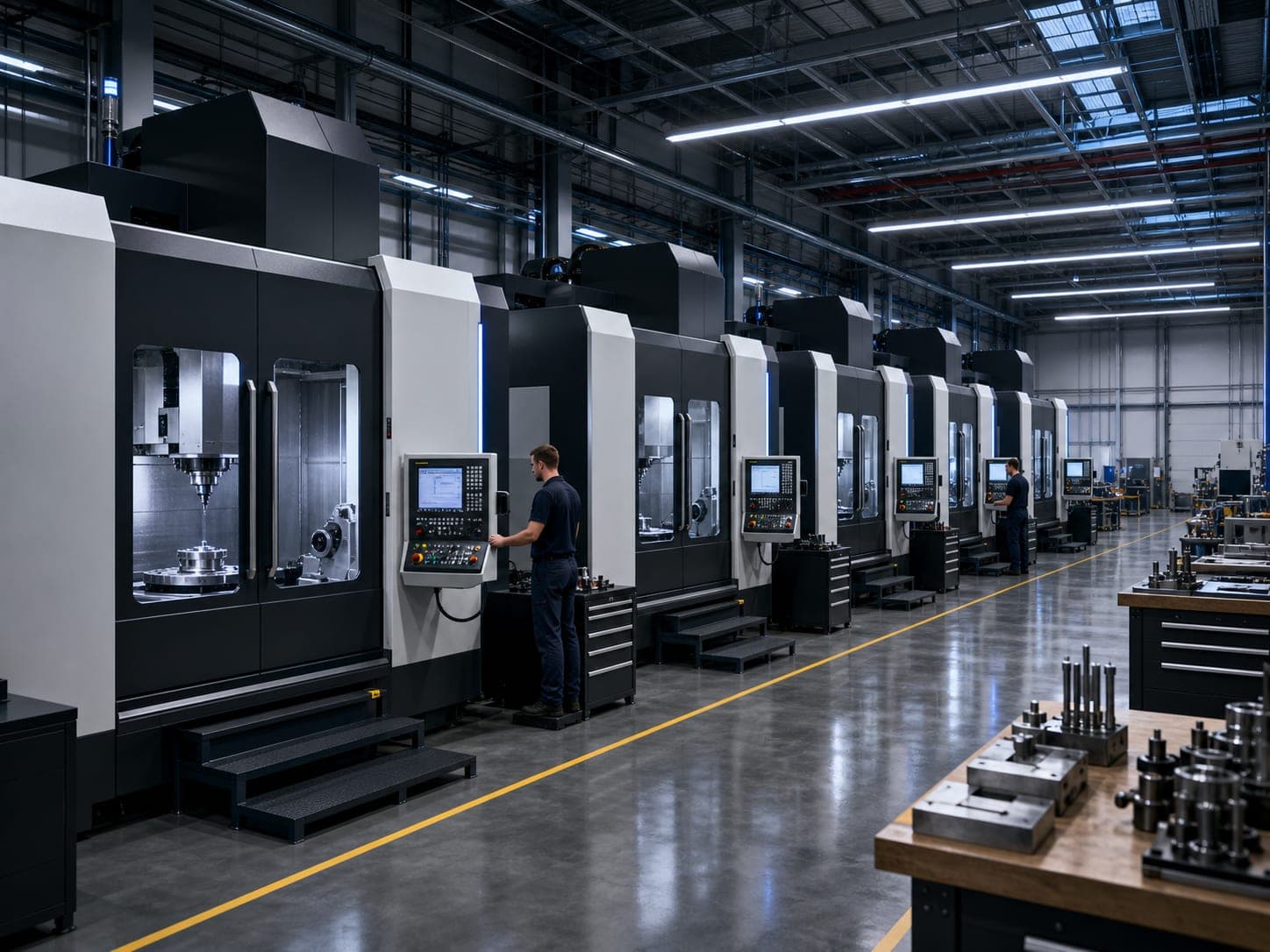
This is the sweet spot. Setup is amortized, machine time dominates, and the hourly-rate gap does the work. A shop like ours runs 18 CNC machining centers and 20 CNC lathes under one roof, so a 500-piece order can be split across several machines and finished in the same 5 to 10 day window as a smaller batch. Sea freight becomes viable at this volume, which keeps shipping cost per part low.
Parts with significant machine time
Deep pockets, thin walls, large stock removal, many features: anything that keeps the spindle busy for a long time amplifies the hourly-rate advantage. A part that takes 90 minutes to machine saves far more in absolute dollars than a part that takes 6 minutes.
Parts needing multiple secondary processes
If your part needs machining, then anodizing, then laser marking, then assembly with inserts, the dense Pearl River Delta supply chain lets one supplier coordinate all of it. In the US or Europe, each of those steps often means a separate vendor, separate shipping, and separate lead time.
Families of parts and ongoing programs
Once fixtures and programs exist, repeat orders get cheaper and faster everywhere. But the savings compound more in China because the base rate is lower, and because no-MOQ policies mean you can re-order 20 pieces without a price penalty.
Where China Does Not Save Money (or Saves Very Little)
An honest comparison has to include the cases where a domestic shop wins.
Single prototypes shipped by express air
One aluminum prototype might cost $180 to machine in Shenzhen versus $350 domestically. But DHL or FedEx express on a 2 kg box is commonly $60 to $120, and you may pay duty and brokerage on top. The landed saving shrinks to perhaps $100, and you have waited an extra 3 to 5 days. If you need the part tomorrow to unblock a test, a local shop is often the better call. Where China still wins on prototypes is when you order 5 to 10 design variants at once, because the shipping cost is shared.
ITAR, export-controlled, or defense work
If your part falls under ITAR or similar export-control regimes, it cannot be manufactured outside the permitted jurisdiction regardless of price. This is not a cost question; it is a legal one. The same applies to some government contracts with domestic-content requirements.
Very large or very heavy parts
A 400 kg machined steel weldment is expensive to ship by any method. Freight can exceed the machining saving. Heavy parts tend to stay local unless the batch is large enough to fill a container.
Parts requiring constant in-person iteration
If your engineers need to walk to the machine, look at the chips, and change the drawing three times in a day, proximity has real value. Good Chinese suppliers compensate with fast DFM feedback, video calls, and photos at every stage, but it is not quite the same as being in the building.
Emergency capacity with no lead-time slack
If a line is down and you need a replacement part in 48 hours, the transit time alone rules out overseas sourcing.
Worked Example: Landed Cost for 200 Aluminum Brackets
Let us make this concrete. Imagine a 6061-T6 aluminum bracket, roughly 120 x 80 x 25 mm, machined from billet on a 3-axis mill with two setups, eight tapped holes, clear anodize, and a general tolerance of ±0.1 mm with two ±0.02 mm bores. Quantity 200. Finished weight about 180 g each, so the shipment is roughly 36 kg of parts plus packaging, call it 45 kg gross.
| Cost element | US domestic shop (typical) | Shenzhen shop (typical) |
|---|---|---|
| Unit machining price (incl. material, anodize) | $42 to $58 | $14 to $22 |
| Parts subtotal (200 pcs) | $8,400 to $11,600 | $2,800 to $4,400 |
| FAI / CMM report | $150 to $400 | Commonly included |
| Freight | $80 to $200 ground | $250 to $450 air freight, or $150 to $300 LCL sea |
| Import duty (US, aluminum articles, indicative) | None | Varies widely by HS code and current tariff measures; budget a percentage of the parts value and confirm with your broker |
| Customs brokerage and fees | None | $50 to $150 |
| Incoming QC time (your side) | Same either way | Same either way |
Even after adding freight, brokerage, and a conservative allowance for duty, the Shenzhen route typically lands somewhere around 40 to 55 percent below the domestic price on a batch like this. The exact figure depends heavily on the duty rate applicable at the time of import, which has been volatile for US buyers. The important point is the method: always compare landed cost, not quoted unit price.
Choosing DDP (Delivered Duty Paid) terms removes most of the guesswork because the supplier quotes one number that includes freight, duty, and delivery to your door. We offer EXW, FOB, and DDP on every quote so you can compare on whichever basis suits your purchasing process.
Hidden Costs Buyers Forget to Include
- Import duties and tariffs. Rates depend on the HS classification (machined aluminum, steel, and "parts of machines" are classified differently) and on country-specific measures that can change with little notice. Get a written duty estimate before you commit.
- Freight surcharges. Fuel surcharges, peak-season surcharges, and remote-area fees can add 10 to 30 percent to a headline freight quote.
- Customs brokerage. Someone has to file the entry. Express carriers bundle this; freight forwarders charge separately.
- Payment costs. International wire fees and currency conversion typically cost 1 to 3 percent. Some buyers pay in USD to avoid this.
- Incoming inspection. Your own QC time is a real cost. A supplier that ships CMM and FAI reports with every batch reduces it, because you can spot-check against documented data rather than measuring everything.
- Rework or rejection. This is the cost everyone fears. It is mitigated by vetting the supplier properly (see our 15-point checklist), by insisting on FAI before full production, and by ordering a small trial batch first.
- Time. A 5 to 10 day production window plus 3 to 7 days air transit means roughly two weeks from PO to parts on your bench. Sea freight adds four to six weeks. Build this into your project plan rather than discovering it later.
A Simple Decision Framework
Choose a domestic (US or European) shop when:
- You need one or two prototypes in under a week.
- The part is ITAR or export-controlled.
- The part is very heavy or oversized.
- You expect several rounds of same-day in-person iteration.
- The total order value is small enough that freight and duty erase the saving.
Choose a Chinese shop when:
- You are ordering 20 or more pieces, or multiple variants at once.
- Machine time per part is significant.
- You need machining plus finishing plus assembly from one supplier.
- Your project timeline can absorb a two to three week door-to-door cycle.
- You want to hold unit cost down on an ongoing production program.
Consider Eastern Europe when you are in the EU, need shorter transit, and can accept a price somewhere between China and Western Europe.
Many experienced buyers run a hybrid model: first prototypes locally for speed, then pre-production and production batches from a vetted Chinese partner once the design is stable. This captures the best of both.
How to Get an Accurate China Quote
The fastest way to move from estimates to real numbers is to send a complete RFQ. Include a STEP file, a 2D drawing with tolerances and surface finish callouts, the material grade, the finish, the quantity (and any future quantities you want priced), and your preferred Incoterm. A good supplier will return a quote within 24 hours and will flag DFM issues at the same time. Our process page walks through each step from RFQ to delivery, and our materials page lists the grades we stock.
If you are comparing CNC milling and CNC turning across regions, quote the same drawing to two or three suppliers in each region. The spread inside a region is often as large as the spread between regions, which is exactly why a single headline rate is never the whole story.
Ready to Compare Real Numbers?
OrangeSea has been machining parts in Shenzhen since 2013, ISO 9001:2015 certified, with 18 machining centers and 20 CNC lathes serving buyers in more than 40 countries. Upload your drawings for a free quote within 24 hours, with no minimum order and EXW, FOB, or DDP pricing on request. Request your quote here and see how the landed cost compares for your own parts.
Tags
Related Services & Resources
Ready to Machine Your Parts?
Upload your CAD files and get a detailed quote within 24 hours. No hidden fees, no surprises.
Get a Free Quote →