
Precision Service
5-Axis CNC Machining
Simultaneous and 3+2 five-axis machining for impellers, turbine blades, aerospace brackets, and complex housings. One setup, ±0.01 mm, shipped from Shenzhen in 5 to 10 days.
Overview
What is 5-Axis CNC Machining?
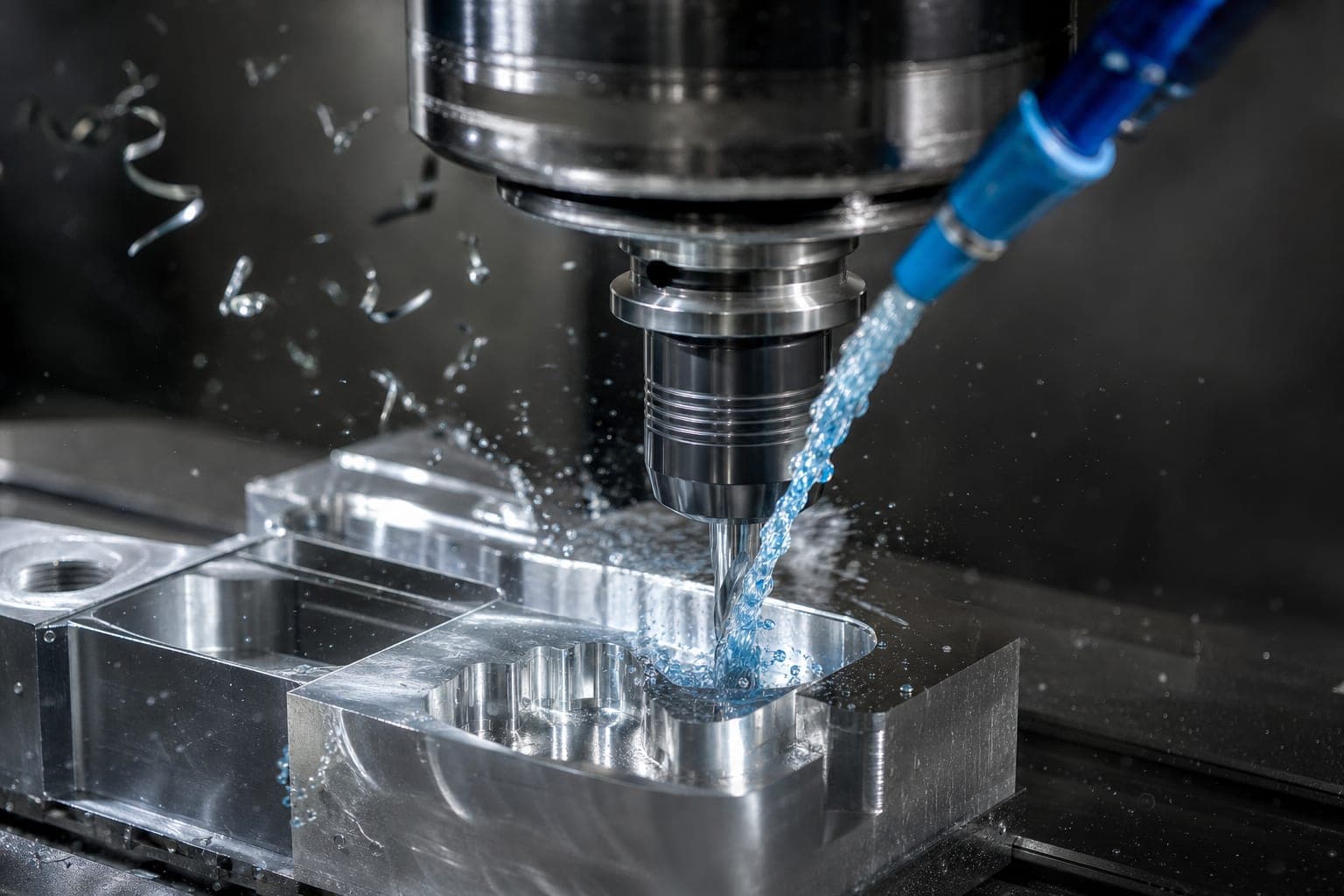
A conventional 3-axis machining centre moves the cutting tool along X, Y, and Z. A 5-axis machine adds two rotary axes, usually a tilting trunnion (A or B) and a rotating table (C), so the workpiece or spindle can be angled relative to the tool. That extra freedom is what lets a single cutter reach the underside of a flange, the inside of a curved impeller passage, or five faces of a manifold block without anyone unclamping the part.
There are two ways to use those axes. In 3+2 positional machining, the rotary axes index the part to a fixed compound angle and the machine then cuts with the three linear axes. It is the workhorse mode for brackets, housings, and any prismatic part with features on several faces. In simultaneous 5-axis machining, all five axes interpolate at the same time, so the tool tip traces a continuous path across a sculpted surface while the tool axis keeps an optimum lead and tilt angle. That is the mode required for turbine blades, blisks, closed impellers, and any geometry defined by freeform surfaces rather than flat faces and holes.
The practical benefits show up in accuracy and cost. Every time a part is moved to a new fixture, positional error stacks up between datums. Machining in one clamping removes that stack-up, which is why our 5-axis work holds ±0.01 mm as standard and ±0.005 mm on critical features. Shorter tools can be used because the spindle tilts toward the surface instead of reaching down past it, so chatter is reduced and surface finish improves. Fewer setups also mean fewer fixtures to design, less operator handling, and a shorter route through the shop, which is how we keep a 5 to 10 day lead time on parts that would need three or four separate operations on 3-axis equipment.
OrangeSea CNC has run 5-axis machining from our Shenzhen facility since 2013 under an ISO 9001:2015 quality system, with 18 CNC machining centres and 20 CNC lathes supporting prototype and production volumes for customers in more than 40 countries. Our programmers simulate every toolpath against a full machine and fixture model before metal is cut, and every finished part is measured on a CMM. Send a STEP file and drawing and you will have a DFM-checked quote within 24 hours, whether you need one titanium bracket or five hundred aluminium housings.
What We Offer
5-Axis Capabilities
Simultaneous 5-Axis
All five axes move together so the tool follows continuous freeform surfaces on impellers, blisks, and blades.
3+2 Positional Milling
Tilt the part to any compound angle and machine five faces in one clamping, with no re-fixturing error.
±0.005 mm Critical Features
Standard ±0.01 mm across the part, tightened to ±0.005 mm on bores, datums, and mating faces.
Deep Cavities & Undercuts
Tilted tool access reaches undercuts, angled ports, and deep pockets that 3-axis tooling cannot.
Hard & Exotic Alloys
Titanium Grade 5, Inconel 718, tool steel, and 7075 aluminium, all with full material certification.
CMM + FAI Documentation
Every 5-axis part is CMM-inspected; First Article Inspection reports on request for aerospace and medical work.
Technical Specifications
Industry Applications
What We Machine in 5-Axis
Aerospace
Impellers, turbine blades, structural brackets, manifold blocks, actuator housings
Energy
Compressor wheels, blisks, pump rotors, turbocharger components
Medical
Orthopaedic implants, bone plates with compound curvature, surgical instrument bodies
Robotics
Joint housings, multi-port hydraulic manifolds, lightweight arm segments
Automotive
Cylinder heads, intake ports, suspension uprights, motorsport uprights and hubs
Moulds & Dies
Core and cavity inserts, electrodes, sculpted forming tools
When does a part need 5-axis?
Not every part does. If your component is a flat plate with holes from one side, 3-axis milling will be cheaper. Five-axis earns its place when a part has features on three or more faces that must be positioned accurately to each other, when surfaces are curved in two directions at once (impeller vanes, blade aerofoils, ergonomic handles), when holes or ports enter at compound angles, or when deep pockets need a short, rigid tool that can only reach by tilting. If you are unsure, send the model; our DFM review will tell you which route is most economical and flag any features that would be cheaper with a small design change.
How It Works
Our 5-Axis Process
DFM Review
We check tool reach, wall thickness, and fixturing before quoting, and return a quote within 24 hours.
5-Axis CAM
Toolpaths are programmed and simulated against the full machine model to eliminate collisions.
Fixture & Setup
Custom fixtures or dovetail workholding expose five faces in one clamping.
First-Off Inspection
The first part is CMM-measured against the drawing before the batch is released.
Production Run
Parts machined in 5 to 10 days, with in-process checks on every critical dimension.
Finish & Ship
Anodising, passivation, or coating, then packing and dispatch EXW, FOB, or DDP worldwide.
FAQ
5-Axis Machining Questions
Supported Materials
What We Machine in 5-Axis
Click any material for full specifications and machinability notes.
Design Tips
Getting the Most from 5-Axis
Every 5-axis part ships with documentation
CMM dimensional report · Material certificate · Certificate of Conformance · First Article Inspection (FAI) on request · ISO 9001:2015 system.
Get a 5-Axis Machining Quote
Upload your STEP file or drawing. DFM review included, NDA by default. Detailed quote within 24 hours.