
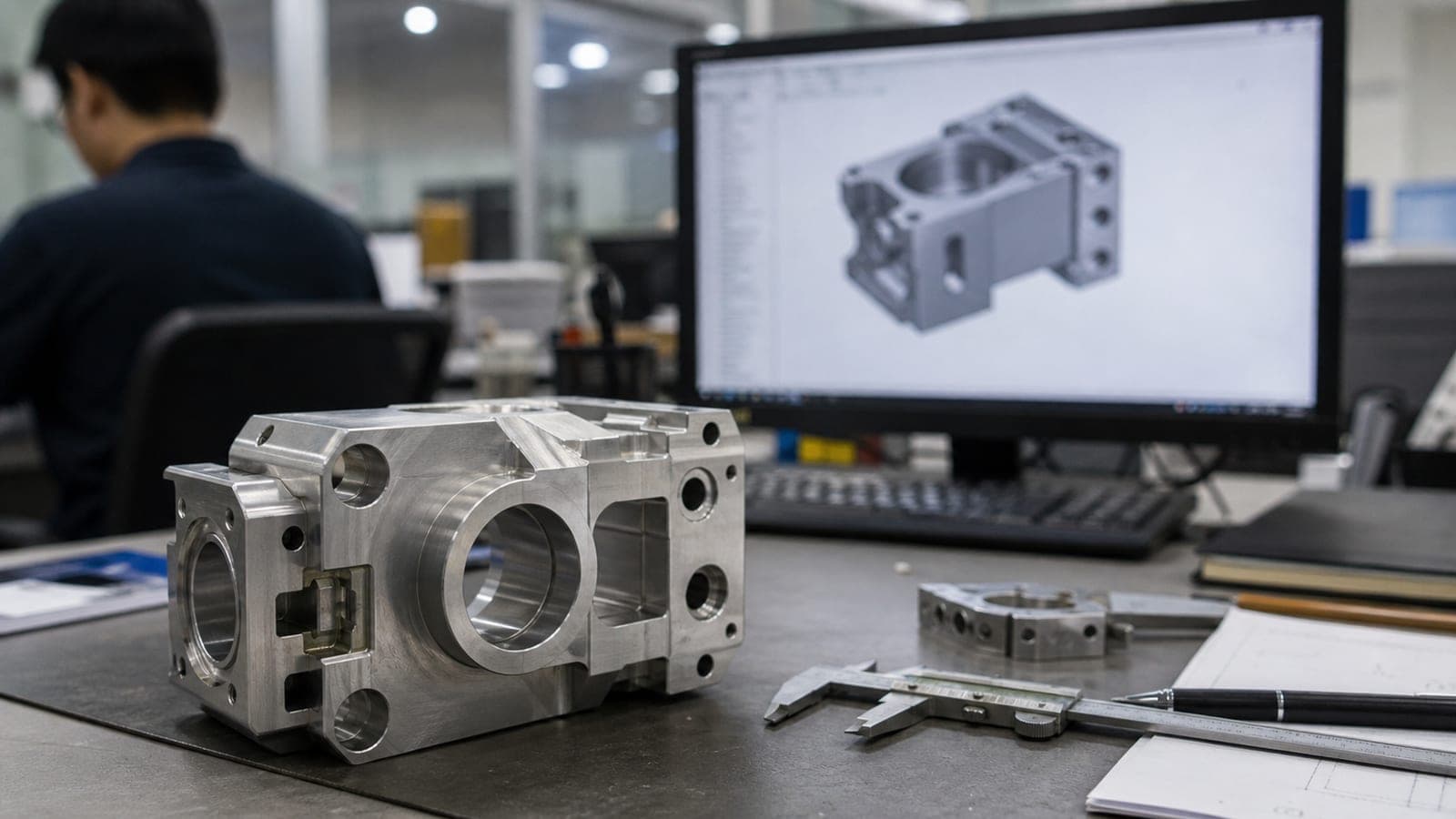
The Journey of a Precision Part
Customers often wonder what happens inside a machine shop after they click "Upload File." The workflow between a CAD model and a finished, inspected, packaged part involves a dozen distinct steps and multiple specialist roles. Understanding this process helps you write better drawings, ask better questions, and set more realistic timelines. Here is a transparent look at how OrangeSea CNC moves a part from enquiry to delivery.
Step 1 — Design for Manufacturability Review
Before any quoting happens, our applications engineers review your STEP file and 2D drawing (if provided) for manufacturability. We look for: internal corners with radii too tight for standard tooling, wall thicknesses that will chatter during machining, thread specifications that require non-standard taps, tolerances tighter than the feature's function requires, and surface finish callouts inconsistent with the machining process. We email a DFM report within 24 hours on all standard orders — this step prevents cost surprises and re-work later.
Step 2 — Quoting and Order Confirmation
Our quoting software extracts the bounding volume and feature count from your 3D model, and our estimators add manual adjustments for difficult-to-machine features, required tooling, and fixturing complexity. The quote includes material cost, machining cost, inspection cost, and shipping, broken out transparently. On acceptance, a purchase order confirmation triggers material procurement and schedules the job on our production floor.
Step 3 — Material Procurement and Incoming Inspection
For standard materials (Al 6061, Al 7075, SS 304/316, mild steel) we maintain stock that covers most orders. Exotic materials — titanium, Inconel, PEEK, Delrin — are ordered per job from approved suppliers. On arrival, each batch of material is logged with its mill certificate, heat number, and chemical composition report. A sample from each lot is hardness-tested and (for critical applications) spectrographically verified before release to production.
Step 4 — CAM Programming
Our CAM programmers load the 3D model into Mastercam or Hypermill and develop the machining strategy: operation sequence, fixturing approach (vice, fixture plate, or custom soft jaws), tool selection, cutting parameters (speed, feed, depth of cut), and toolpath style (adaptive clearing, trochoidal milling, point-to-point drilling). For complex 5-axis parts, the programmer runs a machine simulation to verify there are no collisions between the tool, holder, and fixture before the program ever touches a machine.
Step 5 — Fixturing and First-Off Machining
The machinist sets up the machine: installs the correct tools, measures them with the laser tool-setter, loads the program, and clamps the workpiece. For the first part in any new batch, we machine at reduced feed rate and inspect critical dimensions after each major operation — a process called "first-off inspection." If any dimension falls outside tolerance, the cause is identified and corrected before the rest of the batch runs.
Step 6 — In-Process Quality Control
On production runs, our machinists measure key dimensions every N parts (defined by the control plan) using calibrated gauges, micrometers, or the machine's probing system. Measurements are recorded on traveller documents that follow the job through the shop. Any non-conformance triggers a Stop-Call-Wait procedure: machining stops, quality is called, the disposition is documented before work resumes.
Step 7 — Final CMM Inspection
Finished parts are transferred to our temperature-controlled inspection room where they equilibrate to 20°C before measurement. Our Zeiss CMM runs the part program written from your model and drawing, measuring every drawing callout including GD&T features. The CMM report is saved against the job number. For first articles, customers receive a full dimensional report; for production runs, a certificate of conformance with key dimensions is standard, with full reports available on request.
Step 8 — Finishing Operations
If your order includes surface treatments — anodising (clear, black, hardcoat), electroless nickel plating, passivation, powder coat, or bead blasting — parts are routed to our finishing department or dispatched to approved subcontractors. Finishing is tracked on the traveller and the finished-part coating thickness or appearance is verified against your specification before packing.
Step 9 — Packaging and Shipping
Precision parts are individually wrapped in VCI (vapour corrosion inhibitor) film to prevent transit corrosion, nested in foam-lined boxes or custom trays, and packed to withstand courier handling. Fragile or high-value parts receive custom-machined wooden crating. The shipment is photographed before sealing, and a packing list referencing every part number, quantity, and revision level is included. DHL Express, FedEx, or freight forwarding is arranged per your preference, with full tracking provided.
Total Lead Time
Standard production orders typically complete in 5–10 business days from order confirmation, depending on material availability and complexity. Express 3-day service is available for simple parts in stock materials. Production runs above 100 pieces are quoted individually with a production schedule. Contact Chenny at Chenny@orangeseacnc.com to discuss your specific timeline requirements.
Tags
Related Services & Resources
Ready to Machine Your Parts?
Upload your CAD files and get a detailed quote within 24 hours. No hidden fees, no surprises.
Get a Free Quote →