
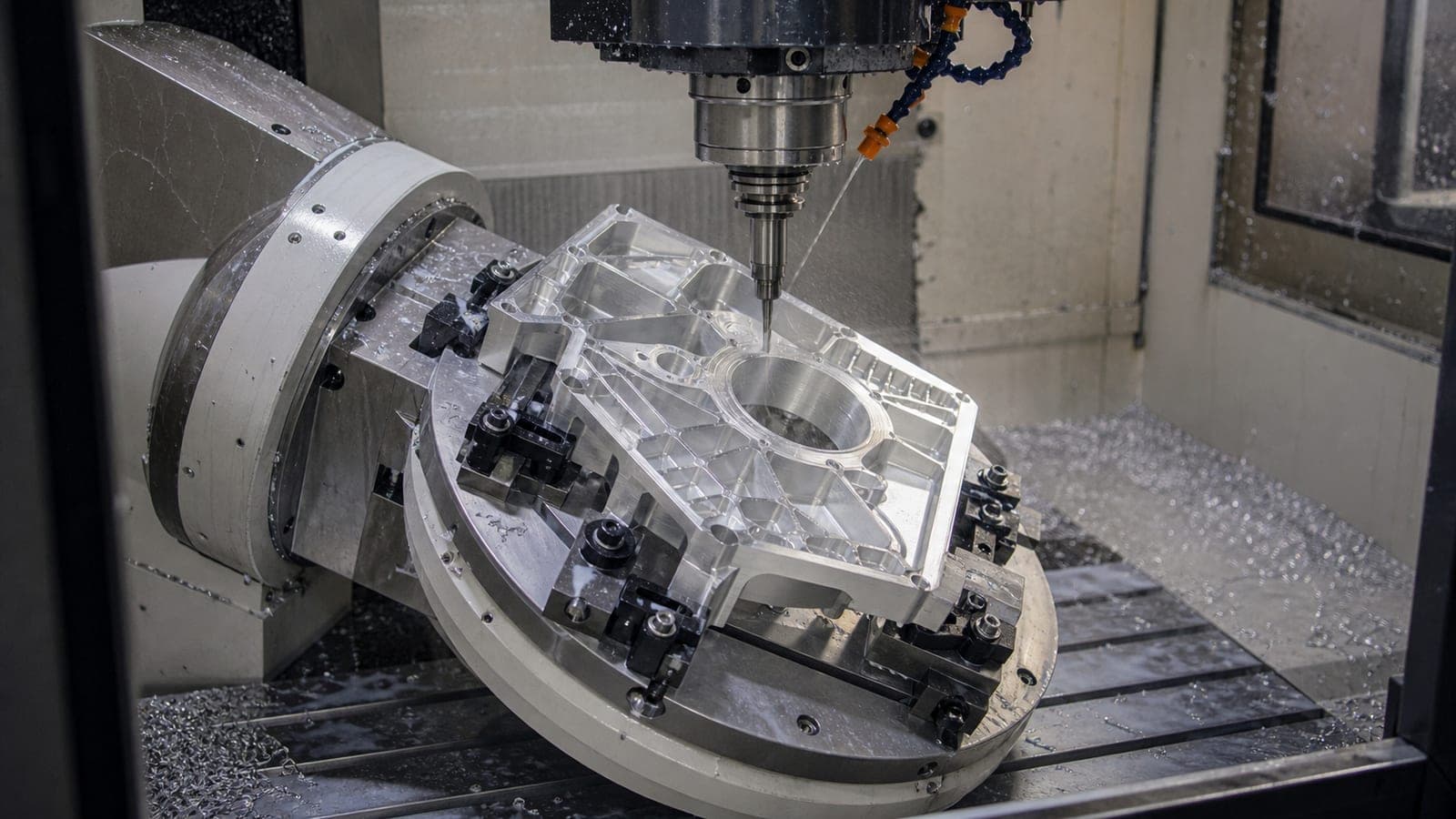
Why Aerospace Manufacturing Demands 5-Axis Capability
Aerospace manufacturing operates under zero-tolerance conditions — a single out-of-spec component can mean catastrophic failure. Over the past two decades, 5-axis CNC machining has risen from a speciality process to an industry baseline across airframe, engine, and avionics manufacturing. The reasons are both technical and economic.
1. Complex Geometries in a Single Setup
Turbine blades, structural brackets, and fuel manifolds share one challenge: they are inherently three-dimensional in ways that no 3-axis machine can address in a single fixture. With simultaneous 5-axis movement — typically X, Y, Z linear axes combined with two rotational axes (A and B, or A and C depending on machine configuration) — a machinist can orient the cutting tool to reach undercuts, deep cavities, and compound angles that would otherwise require multiple setups.
Each additional setup introduces positional error. Datum shifts accumulate. By reducing five or six operations to one, 5-axis machining eliminates those accumulation chains entirely. For titanium structural parts on the Boeing 787 or Airbus A350 family, where tolerances are routinely specified at ±0.025 mm, this matters enormously.
2. Superior Surface Finish Without Secondary Operations
When a cutting tool is tilted relative to the workpiece surface (a technique called "lead angle" adjustment), the effective cutting radius changes. This allows the programmer to maintain a more favourable chip-thinning ratio across sculptured surfaces, producing a finer surface finish in the primary machining operation. Ra values of 0.4 µm or better are routinely achievable on aluminium 7075 aerospace structures without any additional polishing or grinding step.
Secondary operations cost time, money, and introduce handling damage risk. Eliminating them through smart 5-axis toolpaths translates directly to lower per-part cost and shorter lead time — critical when MRO (maintenance, repair, and overhaul) operators need replacement parts within hours, not weeks.
3. Optimised Tool Life on Exotic Materials
Aerospace commonly uses Inconel 718, titanium Ti-6Al-4V, and high-strength aluminium alloys — all of which are aggressive on cutting tools. 5-axis machining enables barrel cutters and taper-form tools to engage large portions of their flute length across a contoured surface, spreading heat and load over a wider area than a traditional ball-nose or end mill used in 3-axis mode. This dramatically extends tool life and reduces the risk of catastrophic insert failure mid-cut — a major concern on expensive near-net billets.
4. AS9100 Traceability and Process Repeatability
Modern 5-axis machining centres integrate with MES (Manufacturing Execution System) software to log every parameter — spindle speed, feed rate, tool ID, coolant pressure — against each job number. This creates the digital thread demanded by AS9100D and NADCAP auditors. When a customer submits a First Article Inspection (FAI) package, the machine data, CMM report, and material certification tie to a single serial number without manual paperwork bridges.
At OrangeSea CNC, our Heidenhain TNC 640 controllers record this data automatically, enabling full traceability on every aerospace shipment.
5. Faster Prototype-to-Production Transition
Because 5-axis programs are constructed from the CAD model geometry rather than from a series of manually planned 3-axis operations, re-programming when a design changes is faster. An engineer modifies the STEP file; the CAM system (Mastercam or Hypermill) regenerates toolpaths; the revised program is on the machine within hours. For aerospace programmes that cycle through multiple design iterations before freeze, this agility saves weeks per development phase.
Conclusion
5-axis CNC machining is not simply a "better" version of 3-axis work — it is a fundamentally different manufacturing paradigm that aligns with what aerospace engineering demands: geometric freedom, dimensional certainty, material efficiency, and documented traceability. If your next programme involves flight-critical hardware, the conversation should start with 5-axis capability from day one.
Tags
Related Services & Resources
Ready to Machine Your Parts?
Upload your CAD files and get a detailed quote within 24 hours. No hidden fees, no surprises.
Get a Free Quote →